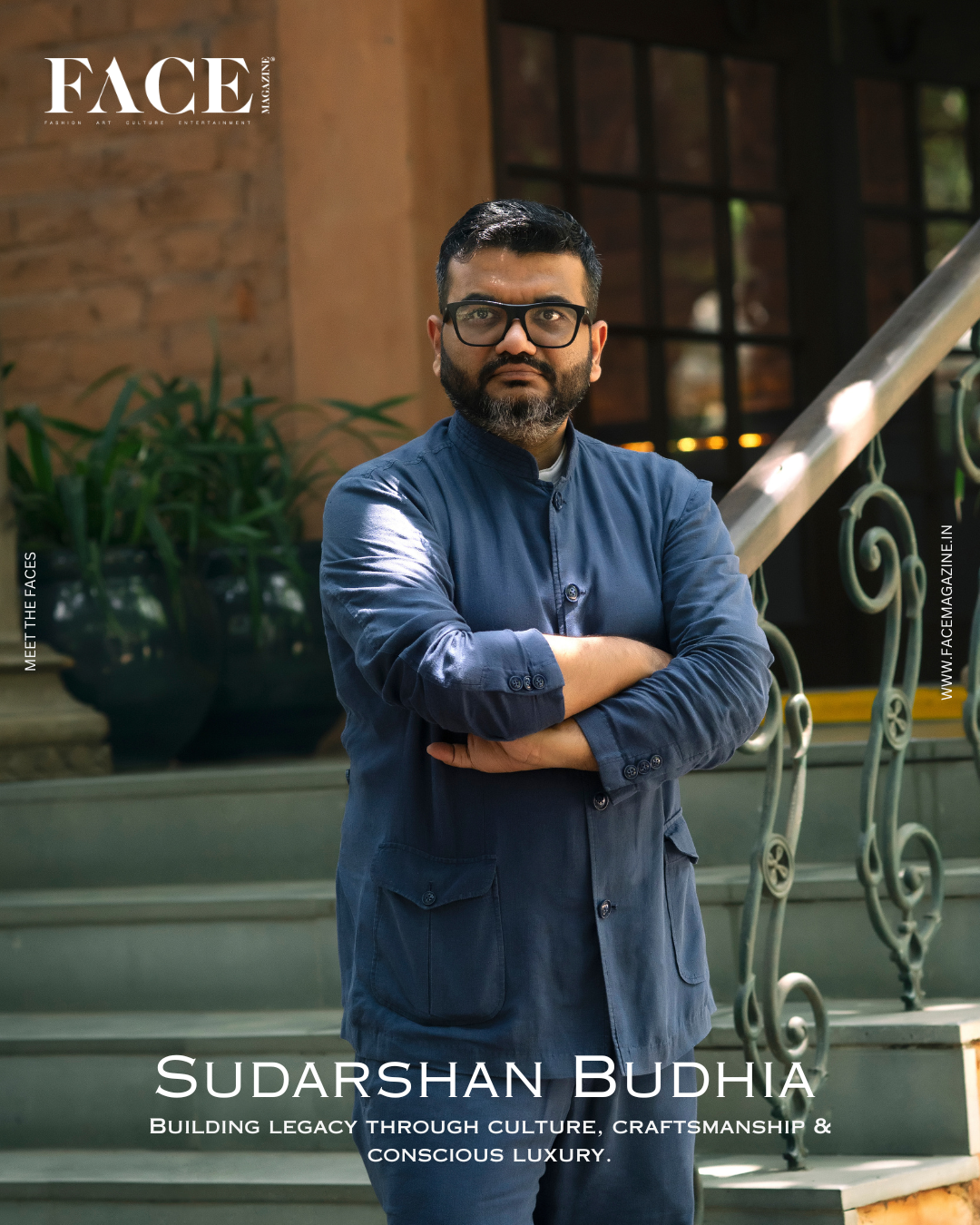
In an era where fashion often moves at the speed of trends, some brands choose to move differently—quietly, consciously, and with purpose. Tapobhumi is one such name. More than a fashion house, it is an evolving philosophy rooted in India’s cultural depth, craftsmanship, and emotional storytelling.
At the helm of this vision is Sudarshan Budhia, a thinker as much as a builder—someone who sees fabric not just as material, but as memory, identity, and expression.
In this exclusive conversation with FACE Magazine, he speaks about building Tapobhumi, preserving authenticity in a fast-moving world, and shaping a legacy that goes far beyond clothing.
A Brand, or a Way of Seeing?
“Tapobhumi is the umbrella—the mother brand that brings together multiple brands, each with its own identity, yet all rooted in a shared philosophy,” Sudarshan begins.
But beyond structure, his definition becomes more poetic.
“It is not just about clothing—it is a reflection of India’s roots, expressed through fabric. It moves quietly yet consistently, much like a temple bell—never loud, yet always resonating with something deeper than what you see and feel.”
One Country, Many Stories
India, as Sudarshan sees it, cannot be spoken to through a single voice.
“You cannot define India as one market—it is layers of markets. Every individual has a different lens—budget, emotion, fabric, color, occasion.”
This understanding led to a distinctive strategy: instead of scaling one brand, he built many.
“Tapobhumi became the foundation, and each brand became a way to speak to a different mindset. Because in a country like India, one story is never enough.”
 Choosing Roots Over Rush
In a world dominated by fast fashion, Tapobhumi stands apart—not by competing, but by opting out.
“We don’t try to compete with fast fashion—we simply don’t belong to that space.”
“Fast fashion moves fast. We move with roots.”
For Sudarshan, the focus has never been on what is trending today, but on what will endure tomorrow. It’s a philosophy anchored in tradition, artisanship, and timeless value—where growth does not come at the cost of authenticity.
Values That Are Lived, Not Written
At the core of Tapobhumi lies its internal philosophy: E.Q.E. — Ethics, Quality, Etiquette.
But for Sudarshan, these are not just guiding words.
“Any philosophy only works if it starts from the top. When there is zero compromise at the leadership level, it naturally flows across the system.”
Consistency, he believes, is the real test of values—not how they are written, but how they are practiced daily.
Where Culture Became Vision
Sudarshan’s journey is deeply intertwined with his upbringing.
“I grew up in an environment where culture wasn’t taught—it was lived.”
From temple aesthetics to festive textures, from art forms like Madhubani to the structured scale of Surat—his exposure shaped a unique perspective.
“Bengal had art but no scalability. Surat had scalability but lacked depth in art. Tapobhumi is the coming together of these two worlds.”
Redefining Luxury
For Sudarshan, luxury is not a price point—it is a feeling.
“It is about how special something makes you feel.”
He draws a parallel with the idea of individuality—where even something simple can feel priceless if it carries emotional value.
“Luxury is that moment where you feel—this is mine, and it is different.”
 From Village to Vogue
His vision—“village to Vogue”—is both expansive and precise.
“It’s about scale across every dimension—price points, regions, occasions, and audiences.”
But more importantly, it is about relevance.
“The real success is when, in a single household, different individuals with different tastes all find something within Tapobhumi.”
Because for him, reach without relevance is incomplete.
When Business Becomes a Movement
There are moments, he shares, when Tapobhumi has felt like something beyond a business.
Particularly when accessibility improved—not just for customers, but for artisans.
“When artisans moved into a more structured environment, where their skills were valued and their earnings improved—you could see the change. The pride came back.”
That shift—from product to impact—is what defines the brand’s deeper purpose.
“It felt like we were enabling a shift. And that’s when it becomes a movement.”
The Balance of Soul and Scale
Building a legacy-driven brand comes with its own challenges.
“Preserving the soul was never the challenge—scaling that soul was.”
Integrating art into a production-heavy ecosystem like Surat, aligning teams, maintaining quality—all while growing—has been the real test.
“It’s a balance we work to earn every single day.”
Learning as a Way of Life
Among Tapobhumi’s guiding principles—Learn, Earn, Serve—one stands above the rest for him.
“Learning. Because everything else comes from it.”
For Sudarshan, learning is not a phase, but a continuous process—one that fuels evolution, execution, and ultimately, purpose.
Beyond Beauty
When someone wears Tapobhumi, he wants them to feel more than just beautiful.
“They should feel confident. They should feel proud.”
Proud of the craftsmanship, the effort, the many skilled hands behind what they wear.
“Because beauty is what people see—but what you feel is what truly stays.”
A Global Responsibility
For Sudarshan, taking Tapobhumi global is not ambition—it is responsibility.
“If the world can adopt western wear so effortlessly, Indian ethnic wear deserves the same space.”
He envisions not just exporting products, but sharing a cultural language—one rooted in history, identity, and emotion.
“If we can carry that forward, that is a journey I am fully committed to.”
The Making of a Legacy
When did it stop feeling like just a business?
“It wasn’t a moment—it was a realization.”
The difficulty of building something that is not easily replicated, the discipline it demands, and the consistency it requires—these are what define a legacy.
“When you build something that is meant to last, it stops being about the present.”
A Message to the Next Generation
His advice to those working with heritage and culture is simple, yet profound:
“Observe deeply, and have patience.”
Because true understanding takes time—and only with patience can that understanding be transformed into something meaningful.
“Without these two, you can create fast products—but not lasting value.”
In a world chasing speed, Tapobhumi chooses stillness. In a market driven by trends, it builds with time. And in doing so, it reminds us—true luxury is not what shines the brightest, but what stays the longest.